Nicksxs's Blog

What hurts more, the pain of hard work or the pain of regret?

springboot 的一个方便之处就是集成了 web server 进去,接着上一篇继续来看下这个 web server 的启动过程
基于 springboot 的 2.2.9.RELEASE 版本
整个 springboot 体系主体就是看 org.springframework.context.support.AbstractApplicationContext#refresh 刷新方法,
而启动 web server 的方法就是在其中的 OnRefresh

try {
				// Allows post-processing of the bean factory in context subclasses.
				postProcessBeanFactory(beanFactory);

				// Invoke factory processors registered as beans in the context.
				invokeBeanFactoryPostProcessors(beanFactory);

				// Register bean processors that intercept bean creation.
				registerBeanPostProcessors(beanFactory);

				// Initialize message source for this context.
				initMessageSource();

				// Initialize event multicaster for this context.
				initApplicationEventMulticaster();

				// Initialize other special beans in specific context subclasses.
                // ------------------> ‼️就是这里
				onRefresh();

				// Check for listener beans and register them.
				registerListeners();

				// Instantiate all remaining (non-lazy-init) singletons.
				finishBeanFactoryInitialization(beanFactory);

				// Last step: publish corresponding event.
				finishRefresh();
			}

跟进去其实本身是啥都不做的,由具体的实现类子类去做各自的处理
org.springframework.context.support.AbstractApplicationContext#onRefresh

/**
 * Template method which can be overridden to add context-specific refresh work.
 * Called on initialization of special beans, before instantiation of singletons.
 * <p>This implementation is empty.
 * @throws BeansException in case of errors
 * @see #refresh()
 */
protected void onRefresh() throws BeansException {
	// For subclasses: do nothing by default.
}

看具体的实现类里就有我们的主角
org.springframework.boot.web.servlet.context.ServletWebServerApplicationContext#onRefresh

protected void onRefresh() {
    super.onRefresh();

    try {
        // -------------> 主要就是这里,创建 webserver
        this.createWebServer();
    } catch (Throwable var2) {
        throw new ApplicationContextException("Unable to start web server", var2);
    }
}

具体的就是一些前置处理
org.springframework.boot.web.servlet.context.ServletWebServerApplicationContext#createWebServer

private void createWebServer() {
    WebServer webServer = this.webServer;
    ServletContext servletContext = this.getServletContext();
    if (webServer == null && servletContext == null) {
        ServletWebServerFactory factory = this.getWebServerFactory();
        this.webServer = factory.getWebServer(new ServletContextInitializer[]{this.getSelfInitializer()});
    } else if (servletContext != null) {
        try {
            this.getSelfInitializer().onStartup(servletContext);
        } catch (ServletException var4) {
            throw new ApplicationContextException("Cannot initialize servlet context", var4);
        }
    }

    this.initPropertySources();
}

初始的 webServer 和 servletContext 都是 null,需要进行初始化
先是获取 WebServer 工厂,
org.springframework.boot.web.servlet.context.ServletWebServerApplicationContext#getWebServerFactory

protected ServletWebServerFactory getWebServerFactory() {
    String[] beanNames = this.getBeanFactory().getBeanNamesForType(ServletWebServerFactory.class);
    if (beanNames.length == 0) {
        throw new ApplicationContextException("Unable to start ServletWebServerApplicationContext due to missing ServletWebServerFactory bean.");
    } else if (beanNames.length > 1) {
        throw new ApplicationContextException("Unable to start ServletWebServerApplicationContext due to multiple ServletWebServerFactory beans : " + StringUtils.arrayToCommaDelimitedString(beanNames));
    } else {
        return (ServletWebServerFactory)this.getBeanFactory().getBean(beanNames[0], ServletWebServerFactory.class);
    }
}

获取了类型是 ServletWebServerFactory 的 bean,然后再回来就是调用的接口方法
org.springframework.boot.web.servlet.server.ServletWebServerFactory#getWebServer
根据具体的 factory 来生成对应的譬如 tomcat 的 factory,
org.springframework.boot.web.embedded.tomcat.TomcatServletWebServerFactory#getWebServer

@Override
	public WebServer getWebServer(ServletContextInitializer... initializers) {
		if (this.disableMBeanRegistry) {
			Registry.disableRegistry();
		}
		Tomcat tomcat = new Tomcat();
		File baseDir = (this.baseDirectory != null) ? this.baseDirectory : createTempDir("tomcat");
		tomcat.setBaseDir(baseDir.getAbsolutePath());
		Connector connector = new Connector(this.protocol);
		connector.setThrowOnFailure(true);
		tomcat.getService().addConnector(connector);
		customizeConnector(connector);
		tomcat.setConnector(connector);
		tomcat.getHost().setAutoDeploy(false);
		configureEngine(tomcat.getEngine());
		for (Connector additionalConnector : this.additionalTomcatConnectors) {
			tomcat.getService().addConnector(additionalConnector);
		}
		prepareContext(tomcat.getHost(), initializers);
		return getTomcatWebServer(tomcat);
	}

最后一行就是创建 TomcatWebServer,
org.springframework.boot.web.embedded.tomcat.TomcatServletWebServerFactory#getTomcatWebServer

/**
 * Factory method called to create the {@link TomcatWebServer}. Subclasses can
 * override this method to return a different {@link TomcatWebServer} or apply
 * additional processing to the Tomcat server.
 * @param tomcat the Tomcat server.
 * @return a new {@link TomcatWebServer} instance
 */
protected TomcatWebServer getTomcatWebServer(Tomcat tomcat) {
	return new TomcatWebServer(tomcat, getPort() >= 0);
}

这里面就开始 new 了一个 TomcatWebServer,
org.springframework.boot.web.embedded.tomcat.TomcatWebServer#TomcatWebServer(org.apache.catalina.startup.Tomcat, boolean)

public TomcatWebServer(Tomcat tomcat, boolean autoStart) {
	Assert.notNull(tomcat, "Tomcat Server must not be null");
	this.tomcat = tomcat;
	this.autoStart = autoStart;
	initialize();
}

再调用里面的初始化方法,org.springframework.boot.web.embedded.tomcat.TomcatWebServer#initialize

private void initialize() throws WebServerException {
		logger.info("Tomcat initialized with port(s): " + getPortsDescription(false));
		synchronized (this.monitor) {
			try {
				addInstanceIdToEngineName();

				Context context = findContext();
				context.addLifecycleListener((event) -> {
					if (context.equals(event.getSource()) && Lifecycle.START_EVENT.equals(event.getType())) {
						// Remove service connectors so that protocol binding doesn't
						// happen when the service is started.
						removeServiceConnectors();
					}
				});

				// Start the server to trigger initialization listeners
				this.tomcat.start();

				// We can re-throw failure exception directly in the main thread
				rethrowDeferredStartupExceptions();

				try {
					ContextBindings.bindClassLoader(context, context.getNamingToken(), getClass().getClassLoader());
				}
				catch (NamingException ex) {
					// Naming is not enabled. Continue
				}

				// Unlike Jetty, all Tomcat threads are daemon threads. We create a
				// blocking non-daemon to stop immediate shutdown
				startDaemonAwaitThread();
			}
			catch (Exception ex) {
				stopSilently();
				destroySilently();
				throw new WebServerException("Unable to start embedded Tomcat", ex);
			}
		}
	}
```  
这里就是继续调用 `org.apache.catalina.startup.Tomcat#start`
```java
    public void start() throws LifecycleException {
        this.getServer();
        this.server.start();
    }
```      
获取server, `org.apache.catalina.startup.Tomcat#getServer`
```java
public Server getServer() {
        if (this.server != null) {
            return this.server;
        } else {
            System.setProperty("catalina.useNaming", "false");
            this.server = new StandardServer();
            this.initBaseDir();
            ConfigFileLoader.setSource(new CatalinaBaseConfigurationSource(new File(this.basedir), (String)null));
            this.server.setPort(-1);
            Service service = new StandardService();
            service.setName("Tomcat");
            this.server.addService(service);
            return this.server;
        }
    }

然后就是启动 server,后面可以继续看这个启动 TomcatServer 内部的逻辑
前面讲了怎么获取 mapping url,继续说下这些mappings 是怎么注册进去的,
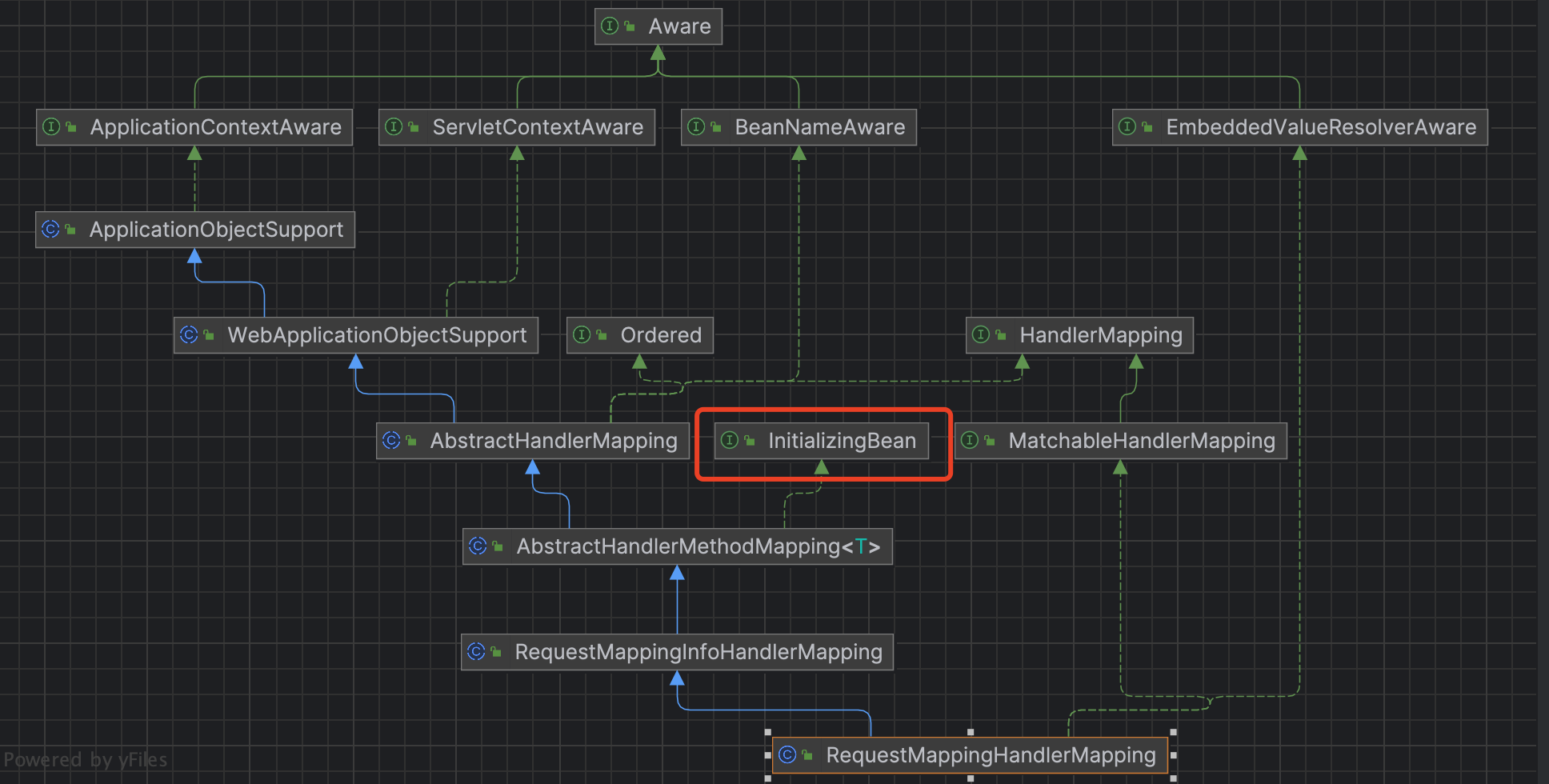
来看下这个 RequestMappingHandlerMapping 的继承关系

可以看到这个类实现了 org.springframework.beans.factory.InitializingBean 这个接口,然后这个 InitializingBean 提供了 org.springframework.beans.factory.InitializingBean#afterPropertiesSet 接口,可以在 bean 初始化后做一些属性设置等,
这里是调用了类本身的 afterPropertiesSet 方法和父类的

public void afterPropertiesSet() {
		this.config = new RequestMappingInfo.BuilderConfiguration();
		this.config.setUrlPathHelper(getUrlPathHelper());
		this.config.setPathMatcher(getPathMatcher());
		this.config.setSuffixPatternMatch(useSuffixPatternMatch());
		this.config.setTrailingSlashMatch(useTrailingSlashMatch());
		this.config.setRegisteredSuffixPatternMatch(useRegisteredSuffixPatternMatch());
		this.config.setContentNegotiationManager(getContentNegotiationManager());

		super.afterPropertiesSet();
	}

父类是 org.springframework.web.servlet.handler.AbstractHandlerMethodMapping#afterPropertiesSet
具体代码很简略,就是初始化 HandlerMethod

@Override
public void afterPropertiesSet() {
	initHandlerMethods();
}

也就是调用了 org.springframework.web.servlet.handler.AbstractHandlerMethodMapping#initHandlerMethods

protected void initHandlerMethods() {
		for (String beanName : getCandidateBeanNames()) {
			if (!beanName.startsWith(SCOPED_TARGET_NAME_PREFIX)) {
				processCandidateBean(beanName);
			}
		}
		handlerMethodsInitialized(getHandlerMethods());
	}

然后就是调用 org.springframework.web.servlet.handler.AbstractHandlerMethodMapping#processCandidateBean

protected void processCandidateBean(String beanName) {
	Class<?> beanType = null;
	try {
		beanType = obtainApplicationContext().getType(beanName);
	}
	catch (Throwable ex) {
		// An unresolvable bean type, probably from a lazy bean - let's ignore it.
		if (logger.isTraceEnabled()) {
			logger.trace("Could not resolve type for bean '" + beanName + "'", ex);
		}
	}
	if (beanType != null && isHandler(beanType)) {
		detectHandlerMethods(beanName);
	}
}

先是获取的 beanType,在判断 beanType 是不是 Handler,通过方法 org.springframework.web.servlet.mvc.method.annotation.RequestMappingHandlerMapping#isHandler

@Override
protected boolean isHandler(Class<?> beanType) {
	return (AnnotatedElementUtils.hasAnnotation(beanType, Controller.class) ||
			AnnotatedElementUtils.hasAnnotation(beanType, RequestMapping.class));
}

就很简单,判断是不是有 Controller 注解或者 RequestMapping 注解
然后就是判断 HandlerMethod 了,调用了 org.springframework.web.servlet.handler.AbstractHandlerMethodMapping#detectHandlerMethods

protected void detectHandlerMethods(Object handler) {
		Class<?> handlerType = (handler instanceof String ?
				obtainApplicationContext().getType((String) handler) : handler.getClass());

		if (handlerType != null) {
			Class<?> userType = ClassUtils.getUserClass(handlerType);
			Map<Method, T> methods = MethodIntrospector.selectMethods(userType,
					(MethodIntrospector.MetadataLookup<T>) method -> {
						try {
							return getMappingForMethod(method, userType);
						}
						catch (Throwable ex) {
							throw new IllegalStateException("Invalid mapping on handler class [" +
									userType.getName() + "]: " + method, ex);
						}
					});
			if (logger.isTraceEnabled()) {
				logger.trace(formatMappings(userType, methods));
			}
			methods.forEach((method, mapping) -> {
				Method invocableMethod = AopUtils.selectInvocableMethod(method, userType);
				registerHandlerMethod(handler, invocableMethod, mapping);
			});
		}
	}

前面先通过 getMappingForMethod 找出有 Mapping 的方法,

@Override
@Nullable
protected RequestMappingInfo getMappingForMethod(Method method, Class<?> handlerType) {
	RequestMappingInfo info = createRequestMappingInfo(method);
	if (info != null) {
		RequestMappingInfo typeInfo = createRequestMappingInfo(handlerType);
		if (typeInfo != null) {
			info = typeInfo.combine(info);
		}
		String prefix = getPathPrefix(handlerType);
		if (prefix != null) {
			info = RequestMappingInfo.paths(prefix).options(this.config).build().combine(info);
		}
	}
	return info;
}
@Nullable
private RequestMappingInfo createRequestMappingInfo(AnnotatedElement element) {
	RequestMapping requestMapping = AnnotatedElementUtils.findMergedAnnotation(element, RequestMapping.class);
	RequestCondition<?> condition = (element instanceof Class ?
			getCustomTypeCondition((Class<?>) element) : getCustomMethodCondition((Method) element));
	return (requestMapping != null ? createRequestMappingInfo(requestMapping, condition) : null);
}

然后再是对 Method 循环调用 org.springframework.web.servlet.handler.AbstractHandlerMethodMapping#registerHandlerMethod
可以看到就是上一篇的 org.springframework.web.servlet.handler.AbstractHandlerMethodMapping#mappingRegistry 去存储映射信息

protected void registerHandlerMethod(Object handler, Method method, T mapping) {
	this.mappingRegistry.register(mapping, handler, method);
}

最后是真的注册逻辑

public void register(T mapping, Object handler, Method method) {
			// Assert that the handler method is not a suspending one.
			if (KotlinDetector.isKotlinType(method.getDeclaringClass())) {
				Class<?>[] parameterTypes = method.getParameterTypes();
				if ((parameterTypes.length > 0) && "kotlin.coroutines.Continuation".equals(parameterTypes[parameterTypes.length - 1].getName())) {
					throw new IllegalStateException("Unsupported suspending handler method detected: " + method);
				}
			}
			this.readWriteLock.writeLock().lock();
			try {
				HandlerMethod handlerMethod = createHandlerMethod(handler, method);
				validateMethodMapping(handlerMethod, mapping);
				this.mappingLookup.put(mapping, handlerMethod);

				List<String> directUrls = getDirectUrls(mapping);
				for (String url : directUrls) {
					this.urlLookup.add(url, mapping);
				}

				String name = null;
				if (getNamingStrategy() != null) {
					name = getNamingStrategy().getName(handlerMethod, mapping);
					addMappingName(name, handlerMethod);
				}

				CorsConfiguration corsConfig = initCorsConfiguration(handler, method, mapping);
				if (corsConfig != null) {
					this.corsLookup.put(handlerMethod, corsConfig);
				}

				this.registry.put(mapping, new MappingRegistration<>(mapping, handlerMethod, directUrls, name));
			}
			finally {
				this.readWriteLock.writeLock().unlock();
			}
		}

底层的存储就是上一篇说的 mappingLookup 来存储信息

最近有个小需求,要把我们一个 springboot 应用的 request mapping 给导出来,这么说已经是转化过了的,应该是要整理这个应用所有的接口路径,比如我有一个 api.baidu1.com 作为接口域名,然后这个域名下有很多个接口提供服务,这些接口都是写在一个 springboot 应用里,如果本身有网关管理这些接口转发的其实可以通过网关的数据输出,这里就介绍下通过代码来获取

RequestMappingHandlerMapping mapping = appContext.getBean(RequestMappingHandlerMapping.class);
Map<RequestMappingInfo, HandlerMethod> map = mapping.getHandlerMethods();
for (Map.Entry<RequestMappingInfo, HandlerMethod> entry : map.entrySet()) {
    Set<String> urlSet = entry.getKey().getPatternsCondition().getPatterns();
    for (String url : urlSet) {
        System.out.println(url);
    }
}

第一行

逐行来解析下,第一行就是从上下文中获取 RequestMappingHandlerMapping 这个 bean,

第二行

然后调用了 getHandlerMethods,
这里面具体执行了

public Map<T, HandlerMethod> getHandlerMethods() {
		this.mappingRegistry.acquireReadLock();
		try {
			return Collections.unmodifiableMap(this.mappingRegistry.getMappings());
		}
		finally {
			this.mappingRegistry.releaseReadLock();
		}
	}

前后加了锁,重要的就是从 mappingRegistry 中获取 mappings, 这里获取的就是
org.springframework.web.servlet.handler.AbstractHandlerMethodMapping.MappingRegistry#getMappings 具体的代码

public Map<T, HandlerMethod> getMappings() {
	return this.mappingLookup;
}

而这个 mappingLookup 再来看下

class MappingRegistry {

	private final Map<T, MappingRegistration<T>> registry = new HashMap<>();

	private final Map<T, HandlerMethod> mappingLookup = new LinkedHashMap<>();

可以看到就是在 MappingRegistry 中的一个变量,至于这个变量是怎么来的,简单的考虑下 springboot 处理请求的流程,就是从 Mapping 去找到对应的 Handler,所以就需要提前将这个对应关系存到这个变量里,
具体可以看这 org.springframework.web.servlet.handler.AbstractHandlerMethodMapping.MappingRegistry#register

public void register(T mapping, Object handler, Method method) {
			// Assert that the handler method is not a suspending one.
			if (KotlinDetector.isKotlinType(method.getDeclaringClass())) {
				Class<?>[] parameterTypes = method.getParameterTypes();
				if ((parameterTypes.length > 0) && "kotlin.coroutines.Continuation".equals(parameterTypes[parameterTypes.length - 1].getName())) {
					throw new IllegalStateException("Unsupported suspending handler method detected: " + method);
				}
			}
			this.readWriteLock.writeLock().lock();
			try {
				HandlerMethod handlerMethod = createHandlerMethod(handler, method);
				validateMethodMapping(handlerMethod, mapping);
				this.mappingLookup.put(mapping, handlerMethod); 

就是在这里会把 mapping 和 handleMethod 对应关系存进去

第三行

这里拿的是上面的 map 里的 key,也就是 RequestMappingInfo 也就是 org.springframework.web.servlet.mvc.method.RequestMappingInfo
而真的 url 就存在 org.springframework.web.servlet.mvc.condition.PatternsRequestCondition
最终这里面的patterns就是我们要的路径

public class PatternsRequestCondition extends AbstractRequestCondition<PatternsRequestCondition> {

	private final static Set<String> EMPTY_PATH_PATTERN = Collections.singleton("");


	private final Set<String> patterns;

写到这下一篇是不是可以介绍下 mapping 的具体注册逻辑

再一次环境部署是发现了个问题,就是在请求微信 https 请求的时候,出现了个错误
No appropriate protocol (protocol is disabled or cipher suites are inappropriate)
一开始以为是环境问题,从 oracle 的 jdk 换成了基于 openjdk 的底包,没有 javax 的关系,
完整的提示包含了 javax 的异常
java.lang.RuntimeException: javax.net.ssl.SSLHandshakeException: No appropriate protocol (protocol is disabled or cipher suites are inappropriate)
后面再看了下,是不是也可能是证书的问题,然后就去找了下是不是证书相关的,
可以看到在 /usr/lib/jvm/java-8-openjdk-amd64/jre/lib/security 路径下的 java.security
jdk.tls.disabledAlgorithms=SSLv3, TLSv1, TLSv1.1, RC4, DES, MD5withRSA,
而正好在我们代码里 createSocketFactory 的时候使用了 TLSv1 这个证书协议

SSLContext sslContext = SSLContext.getInstance("TLS");
sslContext.init(kmf.getKeyManagers(), null, new SecureRandom());
return new SSLConnectionSocketFactory(sslContext, new String[]{"TLSv1"}, null, new DefaultHostnameVerifier());

所以就有两种方案,一个是使用更新版本的 TLS 或者另一个就是使用比较久的 jdk,这也说明其实即使都是 jdk8 的,不同的小版本差异还是会有些影响,有的时候对于这些错误还是需要更深入地学习,不能一概而之认为就是 jdk 用的是 oracle 还是 openjdk 的,不同的错误可能就需要仔细确认原因所在。

最近本来是在读《舞舞舞》,然后看到有介绍说,这个跟《寻羊历险记》是有情节上的关联,所以就先去看了《寻羊历险记》,《寻羊历险记》也是村上春树的第一本成规模的长篇小说,也可以认为是《舞舞舞》的前篇。
最开始这个情节跟之前的刺杀骑士团长还是哪本有点类似,都有跟老婆离婚了,主角应该是个跟朋友一起开翻译社的,后面也开始做广告相关的,做到了经济收益还不错的阶段,也有一些挺哲学的对话,朋友觉得这么赚钱不地道(可能也是觉得这样忘了初心),在离婚以后又结交了一个耳朵很好看的女友,这个女友也是个比较抽象的存在,描述中给人感觉是一个外貌很普通的女孩,但是耳朵漂亮的惊为天人,不知道是不是有什么隐喻,感觉现实中没见过这样的人,女友平时把耳朵遮起来不轻易露出来,只有在跟主角做爱的时候才露出来
主体剧情是因为男主在广告中用了一张一位叫“鼠”的朋友寄给他的一张包含一只特殊的羊的照片,就有个政界大佬的秘书找过来,逼迫主角要找到照片上的羊,这只羊背上有星纹,基本不可能属于在日本当时可能存在的羊的品种,因为这位政界大佬快病危了,所以要求主角必须在一个月内找到这只羊,因为这里把这只神秘的羊塑造成神一样的存在,这位政界大佬在年轻时被这只羊上身,后面就开始在政治事业上大展宏图,就基本成了能左右整个日本走向的巨佬,但近期随着巨佬,身体状态慢慢变差,这只羊就从他身上消失了,所以秘书要主角必须找到这只羊,不然基本会让主角的翻译社完蛋,这样主角就会面临破产赔偿等严重后果,只是说主角本来也一直是这种丧气存在,再说这么茫茫人海找个人都难,还要找这么一只玄乎的不太可能真实存在的羊,所以基本是想要放弃的,结果刚才说的耳朵很漂亮的女友却有着神乎其神的直觉,就觉得能找到,然后他们就踏上了巡羊的旅程,一开始到了札幌,寻找一无所获,然后神奇的是女友推荐一定要住的海豚宾馆,恰恰是一切线索的源头,宾馆老板的父亲正好是羊博士,在年轻的时候被羊上身过,后面离开后就去了那位巨佬身上,让巨佬成了真正控制日本的地下帝国的王,跟羊博士咨询后知道羊可能在十二瀑镇的牧场出现过,所以一路找寻,发现其实这个牧场中有个别墅正好是主角朋友“鼠”的,到了别墅后出现了个神秘的羊男,这个羊男真的不太明白是怎么个存在,就是让主角的女友回去了,然后最后一个肉体承载着“鼠”的灵魂跟主角有了一次接触,主角呆在这个别墅过着百无聊赖的生活,在才到有一次羊男来跟他交流的时候其实是承载着鼠的灵魂,就觉得是不是一切都是在忽悠他,离一个月期限也越来越近了,而在发怒之后,“鼠”真的出现后,但是不是真的“鼠”,而是只有他的灵魂,因为“鼠”已经死了,因为不想被“羊”附身,成为羊壳,并且让主角设定好时钟后的装置后尽快下山,第二天主角离开上了火车后山上牧场就传来爆炸声,“鼠”已经跟羊同归于尽了,免得再有其他人被羊附身,主角也很难过,回到故乡在四周大海已经被填掉了的旧防波堤上大哭悼念逝去的“鼠”。
其实对于没什么时代概念或者对村上一直以来的观念不是特别敏感的,对这本书讲了啥有点云里雾里,后面看了一些简单的解释就是羊其实代表日本帝国主义和资本主义,可能是村上本人反帝国主义,军国主义和资本主义的一个表征,想来也有些道理,不然“鼠”的牺牲就感觉比较没意义,但是另一方面我的理解也可能是对自由的向往的表达,被羊控制,虽然可以成就“伟大”的事业,但是也丧失了自我。

0%